
In renovated buildings, replacement windows and airtightness improvements can reduce unintended air infiltration. Insulation alone does not automatically make a home airtight. When incidental air exchange falls, we need to understand how to provide the ventilation required by the occupants and the building.

Does a black filter prove you need mechanical ventilation?
A photograph of a clean filter beside a dirty one is striking, but does not measure people’s exposure. A dirty filter shows that particles have been captured as air passed through it.
A supply filter treats outdoor air; an extract filter also collects dust and fibres generated indoors. Colour alone cannot identify the material or its potential harm.
The picture is a useful reminder about maintenance. It does not establish indoor air quality or which system was needed. Ordinary particle filters do not remove CO₂ and cannot eliminate all gaseous pollutants.
What mechanical ventilation does
Its main purpose is controlled air exchange. Filtration is an additional function whose effectiveness depends on the system. Ventilation can be centralised or decentralised, and not every system includes heat recovery.
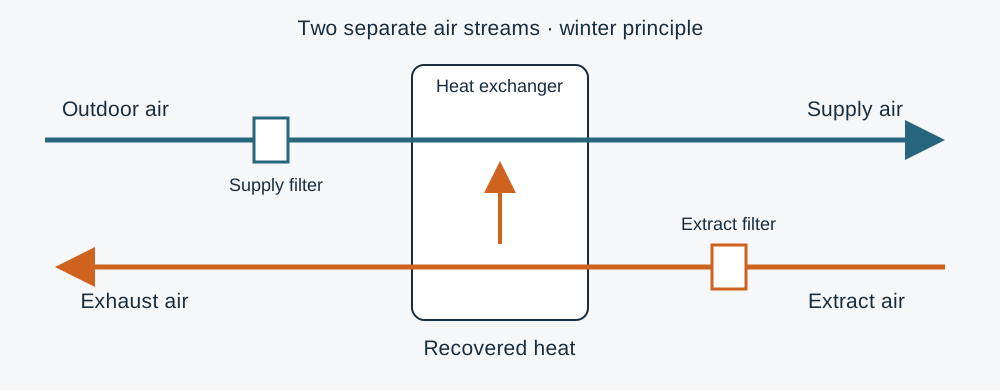
In balanced ventilation with heat recovery, an exchanger transfers some energy from the exhaust air to the incoming air. The diagram shows the winter principle with separate air streams; it is not an installation design.
You can still open the windows
Mechanical ventilation does not prevent you from opening windows. A properly designed and adjusted system can provide routine air exchange without relying entirely on occupants’ habits.
Window ventilation depends on wind, temperatures, opening arrangement and duration. In winter it releases heat; in summer it may provide useful cooling at cooler times or bring in heat and moisture. Outdoor air quality also matters.
Heat recovery does not automatically mean financial savings
Rated recovery efficiency describes performance under defined conditions. An annual assessment includes fan electricity, pressure losses, possible frost protection or preheating, maintenance and replacement filters. Capital cost, climate and the heating system also matter.
Compare options providing equivalent ventilation and indoor conditions. If a home was previously under-ventilated, a new system may improve the air without reducing the bill. Using inadequate ventilation as the baseline would distort the efficiency comparison.
In cold climates, recoverable heat can be substantial. Financial benefits still depend on actual airflow, controls and building use.
Assessment, design and performance verification
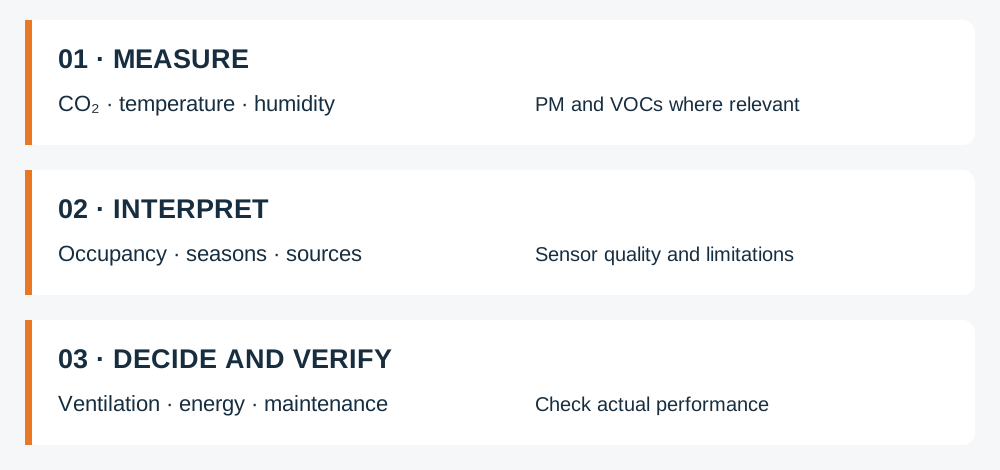
Temperature, relative humidity and CO₂ help describe how rooms are used. CO₂ can inform an assessment of ventilation relative to occupancy, alongside outdoor concentration, number of people, activity and time spent inside. It is not a complete indicator of air quality or a universal health traffic light. [1]
Monitoring can include PM2.5, PM10 and, where relevant, volatile organic compounds. Low-cost sensors have limitations: an aggregate VOC reading does not identify individual substances. Radon requires dedicated instruments and measurement protocols.
Capture representative periods: occupied bedrooms at night, showers, cooking and window opening. Sensor location and reliability matter. A few days may reveal issues without representing every season. Monitoring supports design and does not replace requirements applicable to the project.
Which problem are we solving?
Insufficient ventilation, indoor pollution sources, outdoor noise, moisture and energy consumption need different assessments. Mould and condensation can also involve water ingress, thermal bridges and cold surfaces. Ventilation does not repair a water leak.
Strategies include source control, local extraction, general ventilation and filtration where useful. Natural, hybrid and mechanical options should be compared against achievable performance. A draughty building does not automatically provide adequate air exchange in every room and season. [2]
For mechanical ventilation, check air distribution, measured flow rates, bedroom noise, maintenance access and controls. Good performance also requires verified installation and proper operation.
The NOAH principle
In existing buildings, monitoring and site surveys help identify problems. In new buildings and renovations, air exchange should be considered from the design stage, taking account of occupancy, building characteristics and applicable requirements. There is no need to wait for monitoring to reveal poor air quality before designing adequate ventilation.
Mechanical ventilation is a useful tool when it meets a real need and is properly designed and maintained. Energy efficiency, comfort and air quality should be assessed together.
In both cases, checking performance during use establishes whether the solution actually works.
Understand the building. Design the ventilation. Verify performance.